
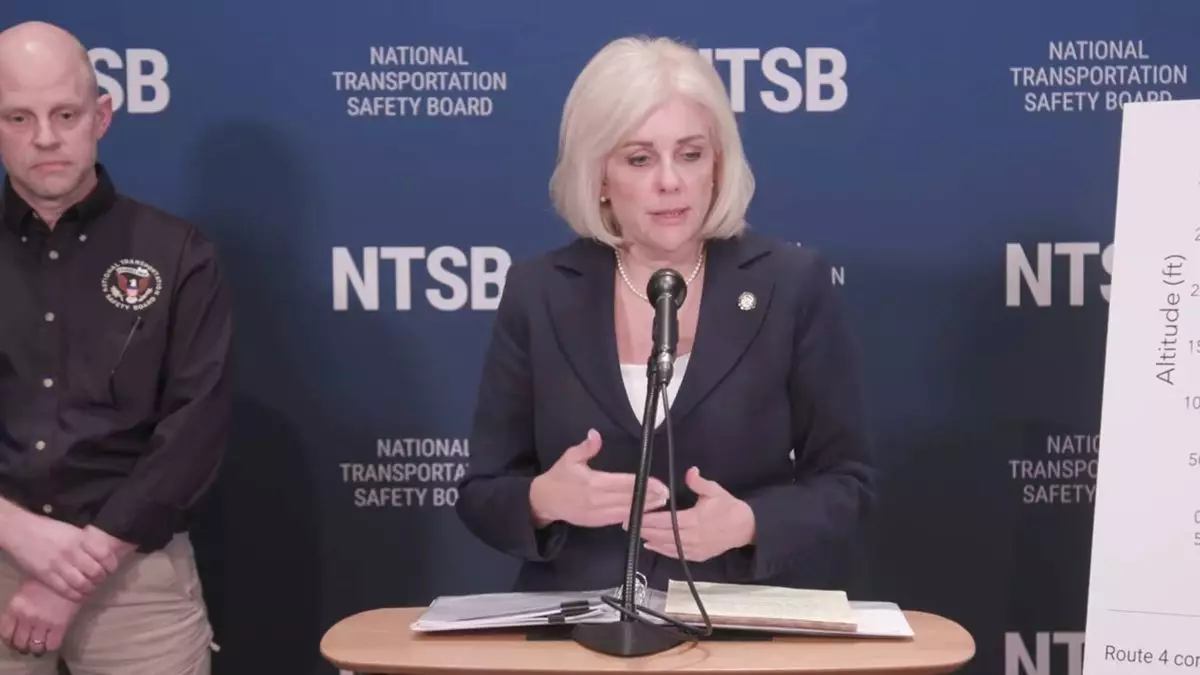
The chilling details surrounding the recent collision between an Army helicopter and a passenger jet have shaken the aviation community. Investigators report that the tragic incident, which took 67 lives in January, highlights the pressing need for immediate reform in how helicopters operate near busy airports. The National Transportation Safety Board (NTSB) has uncovered alarming statistics: from October 2021 to December 2024, there were over 15,000 documented cases of aircraft receiving alerts about nearby helicopters—a clear signal that our air traffic protocols may be dangerously inadequate.
The current standard allows helicopters to operate as close as 75 feet to arriving or departing planes at Reagan National Airport, a distance deemed by NTSB Chairwoman Jennifer Homendy as “insufficient and poses an intolerable risk to aviation safety.” This staggering revelation raises a critical question: How many preventable tragedies must occur before regulatory agencies take decisive action to prioritize the safety of the flying public?
Response and Regulatory Action
In the aftermath of the crash, the Federal Aviation Administration (FAA) has implemented temporary measures to restrict helicopter movements in the vicinity of Reagan National Airport. These steps, while necessary, should serve as a mere starting point rather than a concluding solution. Temporary flight hold protocols now aim to ensure helicopters and airplanes do not share the same airspace during arrivals and departures. However, such reactive measures often fall short of addressing the systemic flaws that put lives at risk in the first place.
To genuinely enhance aviation safety, the scope of these regulations must expand beyond temporary halts. Comprehensive redesign of air traffic management must be prioritized, potentially involving increased physical separation distances for helicopters and rigorous assessments of communication protocols to ensure no critical instructions go unheard.
Technological Failures and Human Errors
Investigators have identified potential human errors and technological malfunctions that contributed to the collision. It appears that the helicopter may have received faulty altitude readings prior to the crash while the crew, equipped with night-vision goggles, may have missed crucial communications from air traffic control. This incident underscores the intersection of human error and technology, urging us to examine how we can create redundancy systems to safeguard against such vulnerabilities.
Utilizing advanced simulation training for pilots and air traffic controllers could further reduce the chances of miscommunication during intense operational periods. Investing in such training would be a step towards fostering a culture of safety that proactively anticipates challenges rather than only reacting to tragedies.
An Urgent Call for Industry-Wide Reform
What this collision ultimately highlights is not simply a failure of one flight or one crew, but a broader systemic issue in the aviation industry. As the skies over Washington D.C. grow more crowded, we must demand an overhaul of existing regulations that inadequately address the complexities of operating diverse types of aircraft in shared airspace.
The NTSB’s recommendations, which include a ban on specific low-altitude helicopter flights, signal a crucial acknowledgment of our current shortcomings. Yet, will the industry act decisively, or will regulatory agencies continue to apply temporary fixes to deep-seated problems? As concerned citizens, we must advocate for enhanced safety measures that don’t just react to disaster but actively work to prevent future tragedies. The time for change is now.

- Best Travel Destinations In November - March 8, 2026
- How Far Can A Tsunami Travel - March 8, 2026
- Bible Verses For Safe Travel - March 8, 2026
Leave a Reply